
Where will your competitive advantage come from once everyone uses AI?
A year of interviews for my book "AI-Q" revealed the answer.

That question came from the floor at a panel in London earlier this summer, hosted by Canva, on what financial services looks like when humans and AI coexist in the workplace.
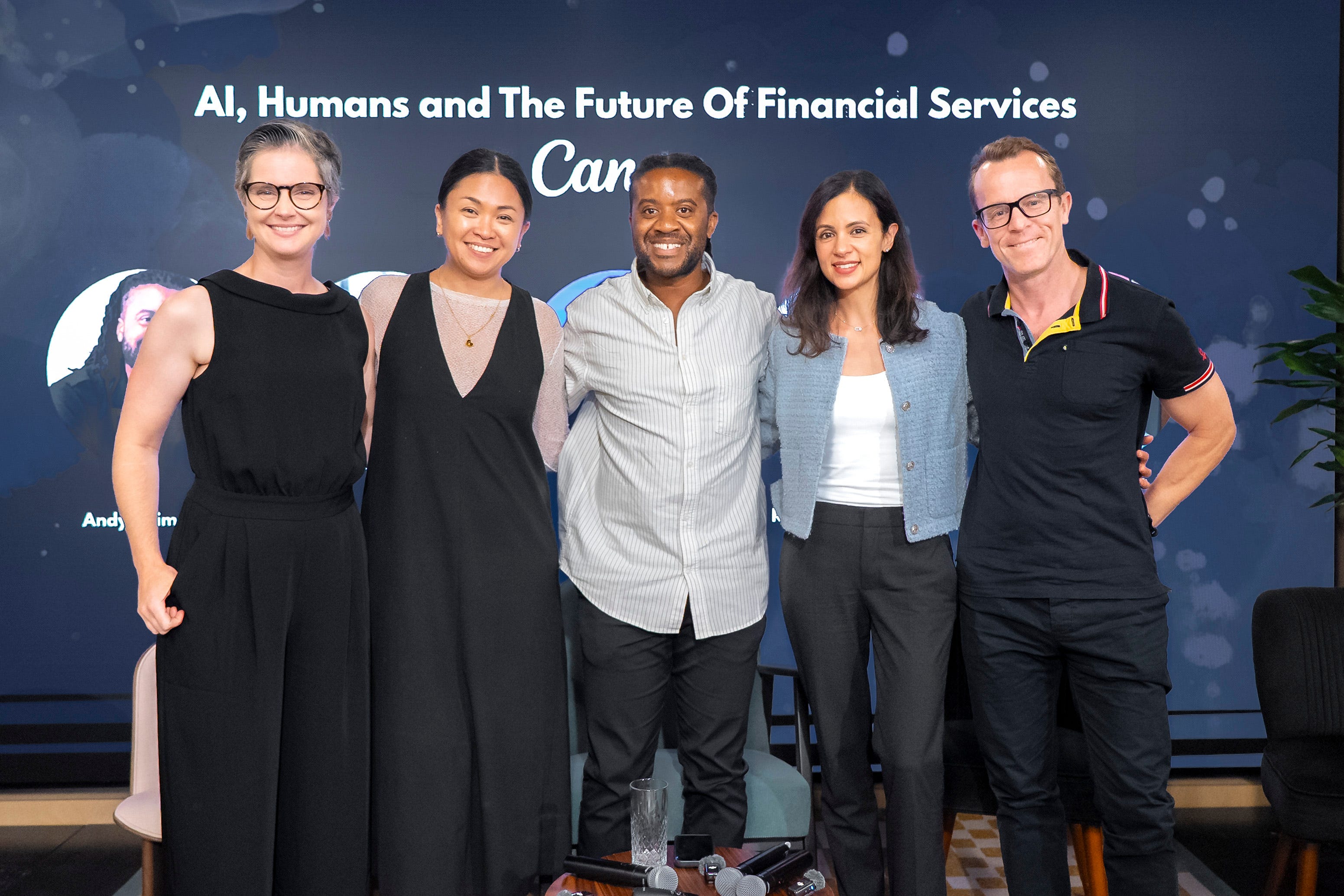
I was on stage with Chloe Smith from the CIPD (far left), Cien Solon from Launch Lemonade, Andy Ayim (who was moderating and is in the middle) and James Relph from HSBC (to my right) - that is all of us grinning in the photo above. We had spent most of the session on regulation, on leadership mindsets, on which skills matter next.
Then, near the end, an audience member asked us this question:
“As everyone gets access to AI, where will my competitive advantage come from?”
It was the best question of the night, and the panel had about ninety seconds to answer it. It is also the question at the centre of my forthcoming book AI-Q, so I want to give it the answer it deserves here.
Let’s start with the economics.
The fundamentals
Economic fundamentals tell us that when an input becomes universally available at near-zero cost, it stops being a source of advantage.
For example, electricity was a genuine differentiator for about thirty years and then it was just a utility bill.
Something similar will happen with AI.
Those that understand AI currently have a competitive advantage. I was talking to a Director at a consultancy that runs executive leadership training for senior executives in role transitions. The first thing they are encouraged to do is to get a formal certification in AI. This helps to get them up to speed with what the tech can do. Courses are proliferating. One of the questions I get asked when I deliver board briefing presentations is which one to pick, and some tell me they use AI to help them choose their AI course. Indeed, you can actually get Claude to design one for you, though in a corporate environment people value the structure and the credential that comes with a formal qualification.
This is not just a trend for corporate execs.
More and more of us are investing in our AI literacy skills, building our understanding of the technology, the various tools and where and when to use them. Yet soon that knowledge will be commonplace. As everyone becomes more AI literate, having an AI certification will become table stakes. In fact, I would argue it already is out there. It is just a matter of time until it diffuses across the population.
That brings us to a different question.
If AI knowledge becomes commonplace what helps you stand out as a leader?
If AI tools no longer give you an advantage, then what does?
What the leaders I interviewed for AI-Q told me
These are the questions that drove me to put forward a proposal for a book, taking part in a proposal challenge with Practical Inspiration Publishing, a publishing company that specialises in non-fiction books.
This was nearly one year ago as the proposal run in September 2025. And to my surprise I won the challenge! I have been asked to write a separate article for aspiring authors so look out for that soon.
What followed was a year of interviews with senior leaders about how AI is reshaping their work.
One question I asked every single interviewee, whether they were a Chief Finance Officer or Chief HR Officer, was “what will be the most important ability or skill in the human + AI era?”
Not one single leader said AI. Not one of them said AI literacy.
All of these leaders were from organisations spending real money on this, and none of them named the technology as the differentiating capability.
Is it because it doesn’t matter? Of course it does.
But a bit like financial markets, they have already priced that in to their decision making. Their expectations have adjusted to include AI literacy, and assume that it is the new baseline. What they’re now looking for is what you combine it with.
Five abilities came up again and again:
Critical thinking. Empathy. Strategic thinking. Creativity. Learning agility.
At this point you might be thinking, ok, but these abilities have always been “good to have”. This is not a new list. True. But the issue that emerges as AI becomes commonplace in our lives is further ahead. We are increasingly outsourcing a lot of these things to AI tools. I wrote in an earlier essay “The case for treating childhood as economic infrastructure” how eliminating friction means eliminating the mechanisms through which we build these abilities. As a result, supply is falling. Yet, demand, as my interviewees made unambiguously clear, is rising.
The five, and what is happening to each
1. Critical thinking
As AI generates outputs at speed and scale, your most important contribution is not using it. It is interrogating what it produces: the question you asked, the assumptions and biases baked into the answer, and whether the reasoning holds up.
But research has found that the instinct runs the other way: the more we trust the output, the less we examine it.
It can also be hard to have the discipline of slowing down to apply critical thinking when AI seems to speed things up.
High AI-Q leaders see critical thinking as their biggest differentiator and create verification mechanisms that protect their judgement.
2. Empathy
Emotional triggers to change can hold back AI adoption in companies, regardless of leadership rhetoric about productivity benefits.
Yet much of the economic analysis of AI uses a task-based lens, even though relationships, informal knowledge, and context are decisive in driving change.
Without empathy the risk is that we miss those human dynamics entirely and mis-direct effort and budgets. For example, you might invest in technical training when all your people need is reassurance.
Empathy is also the ability most quietly exposed to substitution, because AI is now genuinely good at producing empathetic-sounding text. That is not the same as understanding how the individuals in your organisation feel about what you are asking them to do.
High AI-Q leaders realize that their approach to AI adoption needs to go beyond an analytical lens, to also include empathy towards their employees, customers, peers and stakeholders.
3. Strategic thinking
AI radically increases the amount of information available to leaders, while doing nothing to resolve the underlying challenge strategy has always faced: making choices under uncertainty.
Worse, the “fear of missing out” on the AI race can drive reactive investment rather than strategic choices. Every pound spent on an AI tool carries the opportunity cost of not spending it where the business has a greater need.
When new competitors can enter your market with a fraction of the headcount and infrastructure you carry, or when AI compresses a three-day task into three hours and breaks your pricing model, the strategic question shifts.
High AI-Q leaders keep returning to the question that opened this essay: “if every firm has access to the same AI, where does our advantage actually come from?”
4. Creativity
Generative AI can produce ideas at scale. But it lacks contextual judgement, which is what you can bring. A two stage study by Stanford researchers compared the creativity of Large Language Models (LLMs) and humans on new research ideas.
Though LLMs outperformed humans in terms of raw ideation output, i.e. number of novel ideas put forward, when those ideas were assessed they were not feasible. The AI ideas looked better on paper and got worse when someone tried to build them. For example, some ideas were too expensive to execute, something that humans inferred because they had lived experience to provide that context.
In the human+AI era, what makes you indispensable as a leader is not raw ideation; it is knowing what your organization can realistically do next.
Leaders with high AI-Q use creativity to push their AI initiatives past efficiency. They go beyond the question “what can we automate?” to ask “what could we now do that we couldn’t before?”
5. Learning agility
Learning agility is the capacity to continuously acquire new skills and adapt to rapid change. This involves learning, unlearning, and creating effective feedback loops that embed learning.
It is the meta-skill that enables all the others that form part of AI-Q. You can’t enhance your strategic thinking or critical thinking without learning agility. You can’t adapt your leadership approach or embrace new ways of working without it. As Dave Light, one of my co-directors at Beacon Thought Leadership, aptly put it: “it’s the skill to end all skills.” Yet it can also be the hardest ability for some experienced leaders to embrace.
Back to our initial question
So, to the person who asked it in that room in London.
Your competitive advantage will not come from access to AI, and it will not come from a certificate proving you understand it. Both of those are diffusing across the market as we speak.
It will come from the abilities everyone agrees are essential and almost nobody is actively building, because the technology that made them essential is also making them harder to acquire. To discover how high AI-Q leaders are boosting their own abilities for the human+AI era, look out for my forthcoming book.
In the next essay we will explore the mindsets of high AI-Q leaders and how to boost your own.
My book, AI-Q: The New Leadership Imperative for the Human+AI Era, is published by Practical Inspiration Publishing on 12 January 2027.
Subscribe below to join the launch list and get access to bonus materials.
Recently on Athenian Intelligence:


