
Your future without AI literacy
Why should you care about this? What problems will the AI literacy gap create for the world, the economy and importantly for YOU and your job?

Building our AI literacy matters. But why? Today I want to look back to look forward. I look back at how past technologies have evolved and what we can learn about the way our future might be if we repeat some of the mistakes of the past.
AI literacy matters….
…For the future of global prosperity
Do you ever think about switching on a light when you walk into a room? Or just pulling out your phone and using the internet to search for something?
Chances are you don’t.
Why?
Because it’s so commonplace that you don’t need to think about it, it’s become so engrained into your routine and daily life that you don’t even give it a second thought.
But that is not the case for everyone in the world.
Electricity has been around for 100 years yet 750 million people still do not have access to it. The internet has been around for 30 years and still 2.6 billion people do not have access to it.
And even among the remaining world population that has access to it, that does not mean they can reap the benefits, because they may not have the literacy and skills to use it. The OECD 2023 Digital Skills and Digital Inclusion report estimates that around 30% of Americans and 42% of Europeans lack basic digital skills, and this is contributing to a growing digital divide: the gap between those who can access and effectively use technology, and those who can’t.
My mum has access to google maps on her phone for example, but she still does not use it to get around because she doesn’t know how to, and it doesn’t feel familiar. This matters because it limits where she can go, and crucially her confidence to try out new places.
Those two innovations, or as economists would call electricity and the internet “general purpose technologies”, have become so important for human progress and our quality of life that they are part of the United Nations Sustainable Development Goals.
I believe that as AI becomes more embedded into the fabric of our everyday lives, it will follow a similar path. The risk is that it will create a new divide in our world, between countries, and even within countries between those that understand and use the technology, and those that do not.
AI literacy matters….
…For our future economies
Did you know Microsoft signed a 20-year deal to purchase power from a Pennsylvania nuclear plant that will reopen in 2028, providing energy for its power-hungry data centres for artificial intelligence (AI)? Microsoft also admitted this year that energy use related to its data centres was endangering its moonshot target of being carbon negative by 2030.
Or that Meta, a company known for the motto “move fast and break things” that in many ways encapsulates all that is wrong with the tech industry’s approach to innovation, said about the free access of their AI to the NHS: “It is in the long run indirectly in our interest to see this ecosystem of Llama-based innovation because it then makes it much easier for us to reincorporate innovations that are out there into our own products.”
Or that the so-called Magnificent Seven now account for 38% of all US R&D spending by publicly listed US firms, growing from 12% in 2012.
The roll out of AI is shifting power dynamics and concentrating it in a handful of companies.
How can we shape AI for good if we don’t even know how it works or where it is being used? How can we hold the tech giants accountable when we are not even aware of their true power?
AI literacy matters….
For the future of business
Businesses are putting big money into AI. Will their investments in the technology pay off without the associated investments into people?
Enterprise AI spending reached $13.8 billion this year, 6x since 2023. And companies are spending $1 trillion on capital for AI projects, such as data centers, chips and other infrastructure.
Beyond the corporate world, governments are rushing to explore how AI can help them solve the backlog of issues that built up during the pandemic and they’ve been unable to cope with. Meta ran its first “hackathon” in Europe asking more than 200 programmers to devise ways to use its Llama AI system in UK public services. In October 2024, Microsoft agreed a five-year deal with Whitehall departments to supply its AI Copilot technology to civil servants.
Those are major transformation projects, yet we know that 7 out of 10 business transformation projects fail. And that AI projects have twice the failure rate of other IT projects.
One of the main root causes of failure is a misalignment between the leadership expectations of outcomes and the reality that people and employees experience on the ground. Research by Accenture on the future of work uncovered such gaps between CxOs and employees. For example, all CxOs that they surveyed—100%—anticipate changes to their workforce, e.g., growing or reducing headcount and implementing plans to reskill. Yet only one in three leaders believe they have the technology expertise or feel they can tell a compelling transformation narrative to lead the change that’s needed.
Leaders need to start taking seriously, and address, worries about the impact of AI on people’s jobs. Think about this: while almost 60% of workers worry about AI eliminating their jobs, less than one-third of C-suite leaders feel job displacement is a worry for their people. Clearly this is a blind spot.
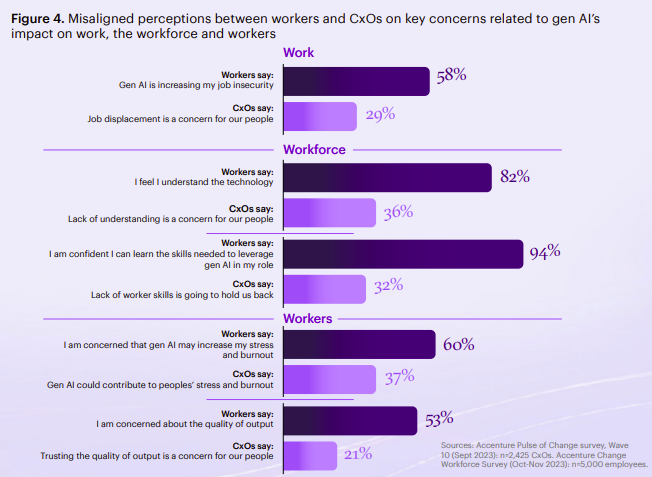
Source: Accenture
It might be that regulation is what forces companies to start taking AI literacy more seriously. The EU AI Act came into force in February 2025 and states that “providers and deployers of AI systems shall take measures to ensure, to their best extent, a sufficient level of AI literacy of their staff and other persons dealing with the operation and use of AI systems on their behalf, taking into account their technical knowledge, experience, education and training and the context the AI systems are to be used in, and considering the persons or groups of persons on whom the AI systems are to be used.”
AI literacy matters….
For your future job
My 5 year old son will need to master skills to thrive in the workplace of the future, skills that I cannot even conceive of.
As our world becomes more complex it becomes harder than before to imagine the jobs of the future. Would my parents for example have thought of prompt engineering when I was 5 years old? Or “social media influencer”? Highly unlikely for many reasons, not least that at the time there was an ‘AI winter’! But joking aside, the point is that new jobs will emerge.
Research by MIT economist David Autor using the US Census Bureau data over the past 100 years has found that 40% of the jobs that we have today didn’t exist in 1940. “We estimate that about six out of 10 jobs people are doing at present didn’t exist in 1940,” says Autor. Interestingly, many new jobs are created by technology. For instance, “Engineers of computer applications” was first codified in 1970, “Circuit layout designers” in 1990, and “Solar photovoltaic electrician” made its debut in 2018. But not all: Some come from consumer demand. “Hypnotherapists” was codified in 1980, and “Conference planners” in 1990. “Technician, fingernail” became a category in 2000. In the future there will be demand for health care services jobs for an aging population.
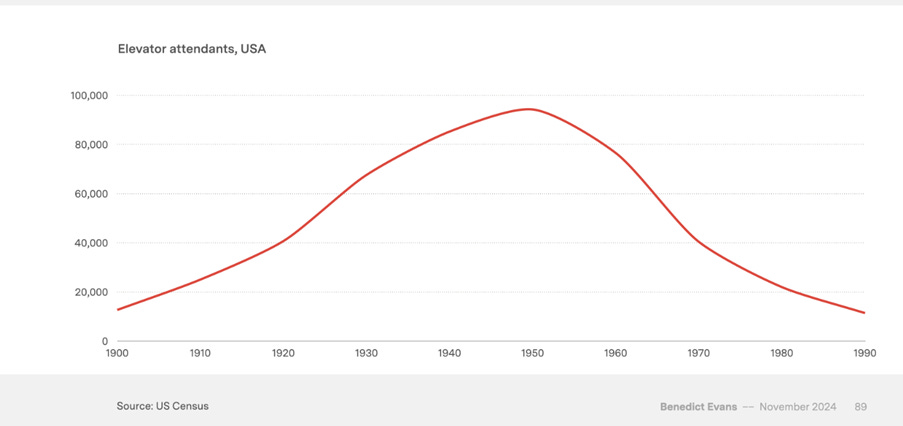
The creation of new jobs will also come with the obsolescence of existing jobs. For example, can you guess what happened in 1950 that lead to the number of elevator assistants plummeting in the US? Otis launched the “Autotronic” automatic elevator.
Which jobs that we have today will disappear or decline? It can be hard to know, but AI literacy will be a key tool for empowerment and individual resilience.
The path forward: Collective AI understanding
We don’t know how AI will evolve.
One response to that uncertainty is to do nothing. Wait and see what happens and decide how to proceed when the need arises.
Another more forward-looking response might be to arm ourselves with knowledge and understanding of what the AI future holds, enabling us to be better prepared.
My vision is to move beyond a world where people are split into AI-optimists and AI-pessimists, into a world united around the importance of AI literacy. AI literacy isn't about becoming a computer scientist, but the need for curiosity on the technology reshaping our world. And this is why curiosity is the future builder.
Share this with others that you think need to know about the problems we face around AI literacy and what it means for our world, our economies, our businesses and our jobs. Join me next week to imagine what that world looks like and how we can illustrate that vision.